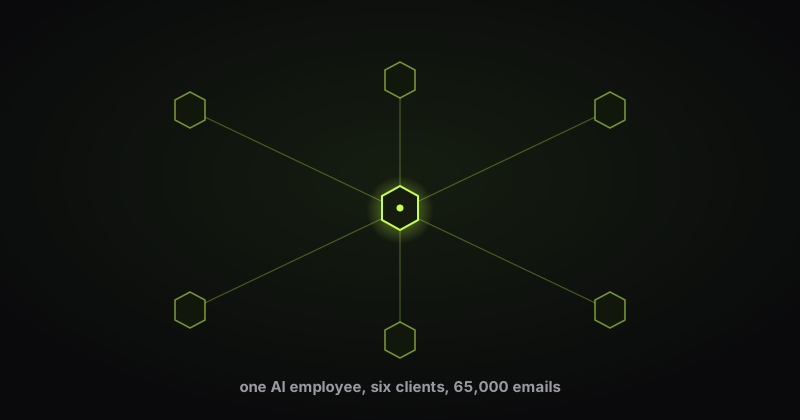
Three months into building 1bee AI, I wanted to know something I genuinely didn't have an answer to yet: could an AI actually run outbound sales for a real company, the whole thing, start to finish, without a human quietly checking its work before anything went out the door? Not assisting a rep. Not drafting something for someone else to approve. Actually running it.
So we built one to find out, and we called him Ross Bee.
He researched the client's product on his own. He built the lead list against their real ideal customer profile, filtering on persona, job title, years of experience, and company revenue, whatever actually mattered for that particular business. He wrote every email himself, and he sent every one of them. Six clients agreed to let us try this on their real pipeline for six months, with no safety net if it went badly, which is honestly more trust than I expected anyone to give us at that stage.
By the time those six months were up, he'd sent something like 65,000 emails to about 20,000 people.
The first real lesson surprised me less than I thought it would, because everyone in sales already knows personalization matters, at least in theory. What actually surprised me was how much it mattered to be specific about the problem, not just the person's name and title sitting at the top of the email. When we wrote emails that named the exact, validated problem a business actually had, rather than a guessed-at pain point, people replied. Noticeably more of them than when we didn't.
What I didn't expect was what happened after someone actually got curious. It didn't make them want to explore some new AI-native way of engaging with us. It made them want the oldest thing in sales there is: a phone call, a calendar link, some kind of proof that an actual person was behind whatever they'd just read.
That's what pushed us toward video, and it came from watching this specific gap rather than from some plan we'd had going in. Here's how it actually worked: during onboarding, the client's own founder or their SDR would sit down and record themselves once, fully, walking through the ideal use cases they wanted to target. We weren't writing scripts for them or putting words in their mouth. From that single recording session, HeyGen let us edit and personalize the video down to the specific problem of whoever we were reaching out to, so the prospect on the other end was seeing and hearing the real person at that company, just speaking directly to their situation. It stopped being an experiment we were testing after the first month and just became part of how every campaign worked.
The reason it worked isn't really a mystery once you think about it. Video is about the fastest way there is to prove that a real company, with a real person who'd stand behind what they were saying, actually sent you something. That's the whole trust gap cold outbound has to close, and text by itself usually can't close it alone.
We also layered LinkedIn and SMS in around the email rather than swapping one out for the other. But none of that lift holds up if it turns into noise, and that risk is real.
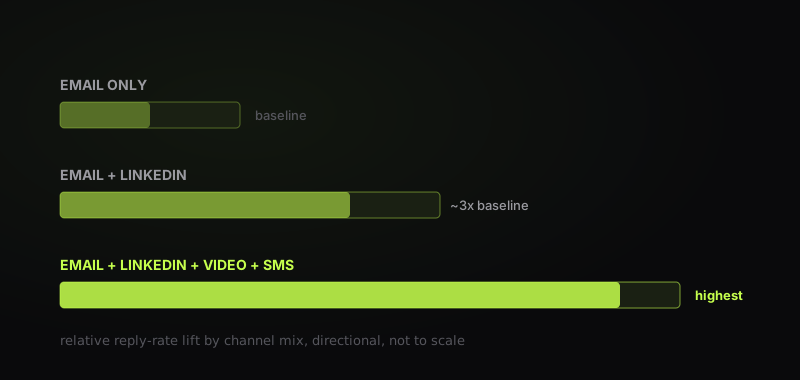
Our approach was to match the channel to how that specific person actually seemed to want to be reached, and if someone genuinely wasn't interested, we'd go quiet for months rather than pile on more pressure through another channel. We were representing our clients' brand every time we hit send on any of this, and that mattered to me more than squeezing out one more reply.
I want to walk through three of the six clients, because the numbers only mean something once you know what was actually happening behind them.
One was a recruitment agency in London with more than 7,000 placements behind them already, and what they needed was both sides of their funnel worked at the same time: meetings with senior leaders who were looking for new roles, alongside a live list of companies hiring urgently. Three months into working together, they were running one and a half times their normal monthly interview volume, and had completed more than 75 demo calls with hiring companies, several of whom mentioned they'd already watched the video and knew exactly who they'd be talking to before the call even started.
Another was a customer-experience company out of Canada, working with names like Mercedes, Porsche, and Radisson, the kind of brands that don't respond to anything that feels remotely generic. Seven weeks in, they'd booked conversations with Volkswagen and with Radisson's hotel group, and their quarterly funnel had improved by roughly three times. But what they actually told us mattered most wasn't the pipeline at all. It was that their outreach manager stopped having to draft replies by hand, because the AI was already answering inbound questions within five minutes and pushing anything that needed a real person's sign-off straight to Slack. Their manager's role quietly shifted from doing the work to approving it.
The third was a mobile device management company, serving both device manufacturers and enterprises managing large fleets of hardware, and they closed roughly $150,000 in new business in two months, entirely from this outbound motion.
None of that, honestly, was the hard part.
The hard part was never the sending itself. Sending is mechanical, and once the system works, it works. What was genuinely difficult was building something that could handle how differently people react to being emailed by an AI in the first place. Some ask you outright if it's AI. Some just go quiet, out of suspicion more than anything else. Some want a human on the phone within the next ten minutes and nothing short of that will do. There's no single right answer that covers all three of those reactions, and getting it wrong doesn't just cost you a reply, it can cost a client their standing with someone who might have been a customer for years.
There's one more decision worth mentioning, and it wasn't an easy one to make at the time. We built our own lead-management platform instead of buying one off the shelf, not because the tools already out there are bad, but because I wanted us to actually understand the mechanics of what we were selling instead of just operating someone else's black box. Across roughly 60,000 emails, we kept our error and bounce rate low, with a person reviewing anything that looked even slightly off before it ever went out. I never wanted a single email to read like it came from a machine. It had to sound like the person it was supposed to be from.
Before any of this, the teams we worked with were losing real hours every day to manual research and one-off personalization that never scaled. Once Ross Bee was running, that became a single command on a dashboard instead. I don't want to publish an exact aggregate number here until I've actually pulled the real figures myself instead of relying on memory, but the direction of the change was obvious to everyone on those teams almost immediately.
That's also why this stopped being something that only worked for small teams. We've since worked with sales organizations of fifteen or more people, for the same underlying reason it worked for six-person teams in the first place. The point was never to replace the humans doing the selling. It was to stop them from spending their day on research a system could do faster, so they could spend it instead on the conversations only a person can actually have.
Ross Bee is now called Mike.
The story above is the real account. What follows is reference material: quick, direct answers to the questions people usually ask after reading it.
Frequently Asked Questions
Does AI outbound sales actually work?
Based on this six-client, six-month run, yes, when it's paired with real personalization and a human reviewing edge cases. The results varied by client, from a 1.5x lift in interview volume to $150,000 in closed business from outbound alone, but none of it worked from a "set it and forget it" AI running unsupervised.
What made the biggest difference in reply rates?
Naming the exact, validated problem a business actually had, rather than a generic pain point. Personalized video came a close second, since it proved a real person was behind the message.
Does personalized video outperform text in cold outreach?
In our experience, consistently yes, though we're reporting that from our own six-client run rather than a controlled, independently-audited study.
How should multi-channel outreach be handled without becoming spam?
Match the channel to how that specific person seems to want to be reached, and back off entirely, for months if needed, once it's clear someone isn't interested.
Can AI replace a sales development rep entirely?
Not in what we've seen. It replaces the manual research and first-draft writing. The decision about when to escalate to a human, and the judgment to know a prospect wants a phone call instead of another message, still needs a person in the loop, at least today.
What this post can't tell you
This is one company's operating history, not a controlled study. Every number above is specific to the six clients and the time period described, and results in a different industry, list quality, or offer could look very different. These are our own results, not independently audited.